Direct factory sourcing for spherical atomized powders, refractory feedstocks, and engineered master alloys designed for laser powder bed fusion (LPBF), metal injection molding (MIM), and powder metallurgy.








How Tier-1 engineering procurement shifts from misleading unit-weight raw powder prices to comprehensive Total Cost of Ownership (TCO), near-net-shape material yields, and crack-free refractory fabrication.
In industrial metallurgy, tungsten (W) possesses an unmatched melting temperature (3,422 °C), an extreme theoretical density of 19.25 g/cm³, a high modulus of elasticity, and superior radiation attenuation. However, conventional subtractive manufacturing of pure tungsten and Tungsten Heavy Alloys (WHAs such as W-Ni-Fe and W-Ni-Cu) is extraordinarily cost-prohibitive. Traditional computer numerical control (CNC) diamond milling and electrical discharge machining (EDM) result in catastrophic cutting tool degradation, microscopic delamination, extreme cycle durations, and scrap rates exceeding 65% to 80% on complex geometries.
Consequently, search queries directed toward a "cheap tungsten additive manufacturing company" do not imply sub-standard metallurgical purity. Instead, global defense, aerospace, nuclear, and medical procurement teams seek manufacturing partners capable of slashing the Total Cost of Ownership (TCO). True industrial cost reduction is achieved via three foundational pillars: high powder sphericity and rheological recovery rates, near-net-shape consolidation eliminating 90% of EDM tooling cycles, and advanced thermal gradient management preventing micro-cracking during rapid solidification.
By leveraging specialized gas-atomized and plasma-spheroidized powder feedstocks alongside optimized Laser Powder Bed Fusion (PBF-LB), Electron Beam Powder Bed Fusion (PBF-EB), and Binder Jet 3D Printing (BJ3D) coupled with debinding and liquid-phase sintering, modern additive manufacturing firms offer up to a 55% reduction in finished component expenditure compared to legacy multi-axis CNC grinding routes.
Strategic applications demanding high-density refractory components without prohibitive machining overheads across high-reliability supply chains.
Direct fabrication of multi-leaf collimators (MLC), gamma camera apertures, and radiation shielding. Additive manufacturing enables curved micro-slits and complex conformal collimation geometry unattainable via traditional lead-casting or tungsten machining, protecting patient safety while drastically reducing lead-time.
Leading edges, kinetic penetrators, propulsion throat liners, and rocket nozzle extensions subjected to extreme heat fluxes exceeding 2,500 °C. AM allows topology-optimized internal regenerative cooling channels that prevent structural failure during atmospheric re-entry.
Plasma-facing components (PFCs) and divertor monoblocks for tokamak fusion reactors. Tungsten's ultra-low hydrogen/tritium retention and resistance to sputtering make it mandatory; additive processing enables monolithic coolant channel integration without brazing weak-points.
Arc chambers, ion optics, and source components in wafer fabrication. Highly pure, gas-free tungsten additive components drastically cut beam contamination, delivering lower maintenance downtime and extended lifespan in corrosive fluorine/chlorine plasma fields.
Understanding the physical-chemical trade-offs between laser bed fusion, high-temperature preheating, binder jetting, and post-consolidation HIP treatment.
| Manufacturing Route | Typical Density | Microstructure & Crack Risk | Production Cost Profile | Optimal Component Envelope |
|---|---|---|---|---|
| PBF-LB with High-Temp Preheating (>800°C) | 99.2% – 99.8% | Ductile-to-Brittle Transition Temperature (DBTT) mitigated; minimal cracking | Moderate to High; premium equipment overhead, zero tooling | Ultra-complex aerospace nozzles, conformal lattice heat sinks, RF collimators |
| Binder Jetting (BJ3D) + Liquid Sintering | 95.0% – 98.5% (As-Sintered) / >99.5% (W-Ni-Fe) | Isotropic grain structure; zero residual thermal stress during printing | Lowest per-unit cost; high throughput for medium-to-large batch series | High-volume radiation shielding bricks, ballast weights, kinetic penetrators |
| Electron Beam Powder Bed Fusion (PBF-EB) | 98.5% – 99.5% | High vacuum environment; ultra-low interstitial oxygen pickup | High capital investment; elevated process temperatures (1000°C+) | PFC fusion divertors, extreme high-voltage vacuum tube anode plates |
| Post-AM Hot Isostatic Pressing (HIP) | > 99.9% Relative Density | Pores collapsed via 200 MPa argon pressure at 1,400°C – 1,600°C | Secondary finishing fee; required only for safety-critical aerospace/nuclear | Flight-critical rocket motor parts, deep-space nuclear propulsion cores |
The primary barrier to scalable, cost-efficient tungsten additive manufacturing is the metal's high Ductile-to-Brittle Transition Temperature (DBTT), which commonly ranges between 200 °C and 400 °C depending on interstitial impurity content (oxygen, nitrogen, carbon). During laser melting, cooling rates exceed 106 K/s. If the local build environment is held below the DBTT, intense thermal contraction stresses inevitably trigger catastrophic intergranular hot cracking along columnar grain boundaries.
Economically competitive tungsten 3D printing vendors overcome this phenomenon via three state-of-the-art technical interventions:
1. High-Temperature Induction Bed Heating: Maintaining the build platform at 800 °C to 1,000 °C dramatically lowers thermal gradients (∇T), ensuring the solidifying melt pool remains in the ductile regime and yielding defect-free monolithic components.
2. Nano-Alloying & Scavenging Agents: Micro-doping with titanium carbide (TiC), zirconium (Zr), or tantalum (Ta) at 0.5–1.5 wt% acts as an in-situ oxygen scavenger while stimulating grain refinement from coarse columnar dendrites to fine equiaxed structures.
3. High-Density Spheroidized Feedstocks: Employing radio-frequency (RF) inductively coupled plasma spheroidization guarantees satellite-free, perfectly round powder particles with Hall flow rates under 8.5 s/50g, ensuring smooth doctor-blade recoating without wiper chatter or low-density voids.
Leveraging decades of Japanese powder metallurgy discipline, gas atomization mastery, and strict industrial quality systems across global supply networks.
Since 1997, Hunan Ningxiang JiWeiXin Metal Powder Co., Ltd. (Toyal JWX) has specialized in gas-atomized spherical powders, developing stable, repeatable batch chemistries and controlled particle size distributions (D10/D50/D90) for high-performance metallurgy.
Jointly acquired in December 2009 by Toyo Aluminium K.K. Group and Shanghai Matsuo Co., Ltd., Toyal JWX integrates rigorous Japanese quality control, certified ISO 9001:2015, ISO 14001:2015, and Safe Production Licenses for total batch traceability.
Modern aerospace demands pairing heavy tungsten radiation shielding and thermal barriers directly with lightweight structural components. Toyal JWX supplies high-purity aluminum alloys, AlSi10Mg, and Aluminum Metal Matrix Composites (AMMC) for unified multi-material systems.
Operating out of the State-level Ningxiang Economic and Technological Development Zone (Hunan Province, China), Toyal JWX commands 10,000 tonnes of annual atomization capacity, serving over 230 enterprise partners across Europe, Southeast Asia, North America, and South America.
From melting and ultrasonic gas atomization to multi-stage inert gas classification, surface treatment, and vacuum packaging under Japanese QA standards.
Complete compliance handling for UN1396 (Class 4.3 dangerous goods) and UN1309 (Class 4.1) powders, supported by batch-specific COA, SDS, and global freight clearance.
Bespoke particle distributions tailored for LPBF (15–53 μm), MIM / Binder Jetting (under 20 μm), and thermal filler silicone/epoxy applications with advanced silane coatings.
Navigating dual-use trade compliance, conflict mineral certification, and localized metallurgical engineering for cross-border supply continuity.
Tungsten alloys and pure refractory powders frequently intersect dual-use export classification lists (such as Wassenaar Arrangement Munitions/Dual-use lists, US EAR/ITAR, and EU Dual-Use Regulation 2021/821). Reputable manufacturing vendors maintain validated End-User Undertaking (EUU) workflows, verified traceability, and full export compliance auditing.
Adherence to OECD Due Diligence Guidance for Responsible Supply Chains of Minerals and the Responsible Minerals Initiative (RMI). Factory lines exclusively source tungsten concentrator feedstocks from certified conflict-free smelters, delivering transparent ESG documentation for Fortune 500 aerospace and medical primes.
Mitigating supply-chain fragility via regional distribution nodes across Europe, North America, and Southeast Asia. Rapid sampling, metallurgical testing (laser diffraction PSD, ICP-OES elemental analysis, LECO gas interstitial verification), and just-in-time powder replenishment prevent factory line stoppages.
Direct, verifiable answers on powder morphology, oxygen contamination thresholds, cost reduction levers, and international shipping protocols.
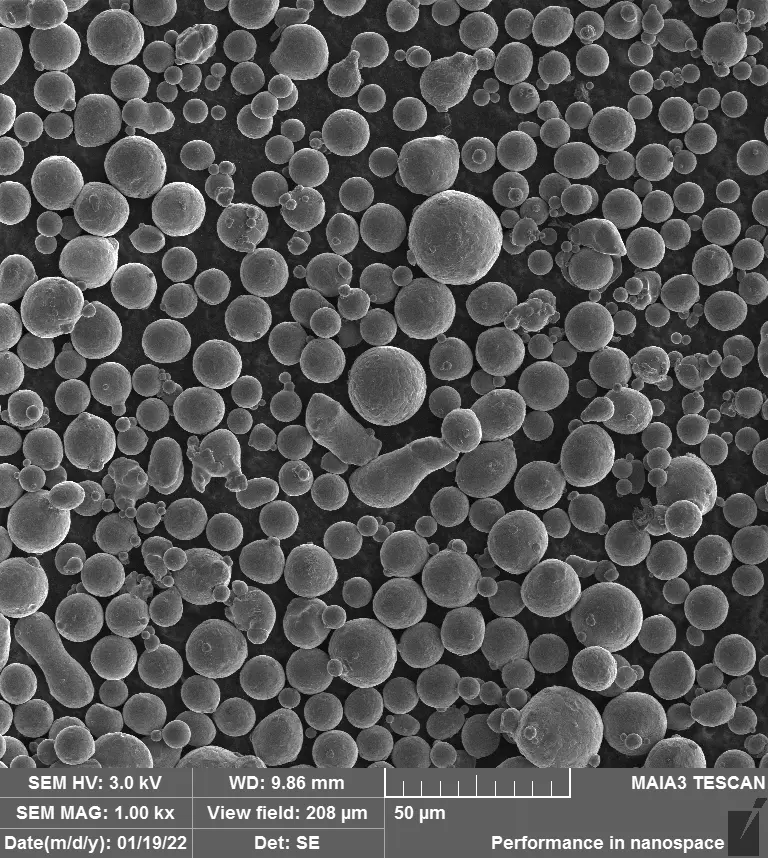
Verified spherical morphologies, narrow PSD spans, and high apparent densities engineered for laser sintering, MIM, thermal filler matrices, and composite reinforcement.

Peer-reviewed articles, trade summit participation, and practical guides on composite materials and advanced additive manufacturing.
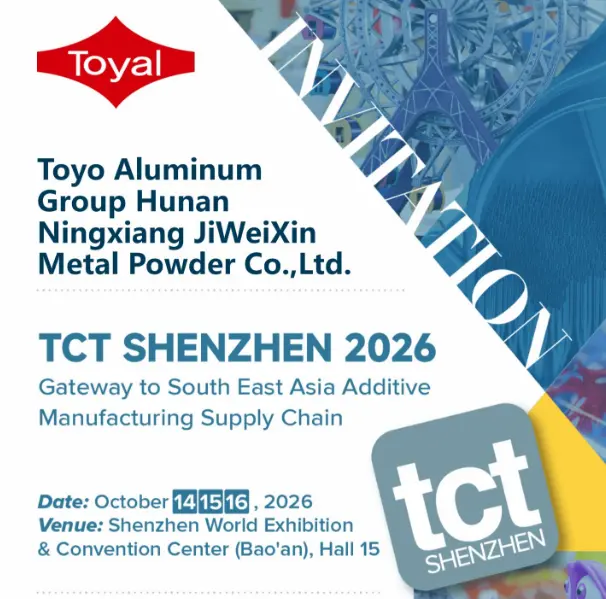
Meet JiWeiXin Metal Powder at TCT Shenzhen 2026, Booth A39, and explore spherical powders, custom PSD sizing, and high-performance alloys engineered for extreme thermal and structural applications.
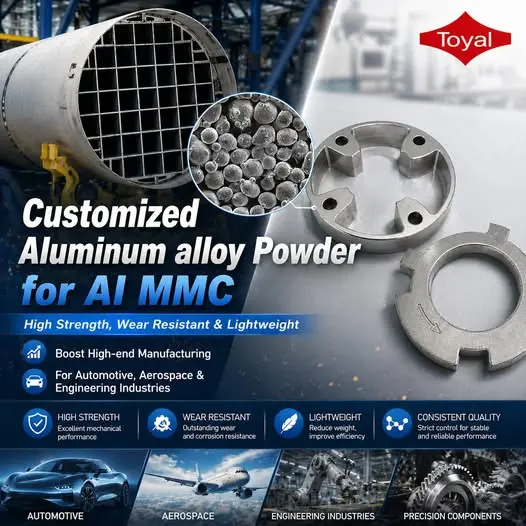
Customized spherical powder solutions for metal matrix composites (AMMC), 3D printing, powder metallurgy, and electronics thermal interface formulations with sub-micron particle consistency.
Why lightweight materials alone are no longer enough, and how ceramic-reinforced AMMC powders empower design engineers to balance low mass, high elastic modulus, and thermal dissipation.
Contact our technical team in Ningxiang National Economic and Technological Development Zone for full powder catalogs, certified SEM/PSD particle analysis, and volume RFQ quotes under strict NDAs.

