Explore our certified spherical powders and custom matrix solutions engineered for additive manufacturing, thermal management, powder metallurgy, and reactive composite sintering.








Why modern engineering procurement prioritizes lifecycle yield, zero-defect gas atomization, and direct manufacturing scalability over short-term cut-rate materials.
In contemporary industrial manufacturing, procurement searches querying "cheap aluminum alloy stainless steel manufacturer & factory" rarely seek sub-standard or defective grades. Instead, senior procurement officers, metallurgical engineers, and supply chain directors are expressing a clear transactional intent: identifying factory-direct manufacturers capable of delivering significant Information Gain, high metallurgical consistency, and aggressive unit cost economics through lean production, high atomization yields, and localized supply chain integration.
When purchasing spherical aluminum powders, Al-Si alloy powders, or austenitic/martensitic stainless steel feedstocks (such as 316L, 17-4PH, and AlSi10Mg), unit purchase price represents merely 35% of the total component cost. The hidden remainder consists of scrap rates caused by satellite particles, flowability degradation, laser absorption variance in Selective Laser Melting (SLM), or segregation in metal injection molding (MIM) binders. Hunan Ningxiang JiWeiXin Metal Powder Co., Ltd. (Toyal JWX), established in 1997 and backed by the prestigious Toyo Aluminium K.K. Group since 2009, operates at the intersection of Japanese metallurgical precision and China's high-efficiency smart manufacturing scale.
"Cost optimization in metallurgy is not achieved by sacrificing raw material purity; it is engineered through closed-loop inert gas atomization efficiency, automated particle classification yields, and continuous process monitoring that eliminates downstream sintering failure."
By controlling the end-to-end industrial chain within the Ningxiang National Economic and Technological Development Zone—from raw electrolytic ingot melting and supersonic gas atomization to multi-stage cyclonic sieving, specialized surface passivation, and automated hermetic packaging—Toyal JWX offers the global market authentic, factory-direct cost advantages without compromising strict ISO 9001:2015 and ISO 14001:2015 engineering integrity.
Exploring the convergence of lightweighting, extreme thermal transfer, and additive manufacturing in high-throughput industrial sectors.
Laser Powder Bed Fusion (LPBF) and Direct Energy Deposition (DED) have migrated from prototyping to serial production. Highly spherical AlSi10Mg, Scalmalloy, and gas-atomized 316L/17-4PH stainless powders demand precise Hall flow rates (<25 s/50g) and strict satellite-free morphology to ensure uniform powder spreading at 30 to 80-micron layer thicknesses.
With the surge in high-power EV inverters, 800V battery architectures, and ultra-dense AI server computing clusters, spherical aluminum powders and coated dielectric metallic fillers have become essential. Formulating TIM pads, thermal greases, and silicone potting compounds with our high-packing powders achieves conductivities exceeding 5–8 W/m·K.
Ceramic-reinforced aluminum metal matrix composites (e.g., Al-SiC or Al-TiB₂) offer high specific stiffness, improved fatigue resistance, and low thermal expansion coefficients. Uncoated atomized spherical aluminum powders serve as the ideal baseline matrix for homogeneous solid-state blending and hot isostatic pressing (HIP).
| Material Family / Grade | Primary Industrial Sector | Particle Size (PSD) Options | Key Mechanical & Physical Features | Economic Advantage Level |
|---|---|---|---|---|
| Spherical Pure Al (>99.7%) | Thermal Interface Materials, Conductive Pastes | 1–5 µm, 5–15 µm, 15–45 µm | High thermal conductivity (205 W/m·K), low tapping resistance | High Cost-Efficiency |
| AlSi10Mg / AlSi7Mg Alloys | Aerospace & Automotive 3D Printing (LPBF) | 15–53 µm, 20–63 µm | High dynamic strength, excellent weldability, low porosity | Direct OEM Advantage |
| Al-Si Powder for Brazing | Automotive Radiators & HVAC Heat Exchangers | 20–75 µm (Customized) | Optimal eutectic melt point, rapid wetting, flux-compatible | Mass Production Yield |
| Surface-Coated Al Powders | Potting Compounds, Polymer Dielectrics | 2–30 µm (Silane/Stearic) | High filler loading in silicone (>85 wt%), anti-oxidation barrier | Proprietary Formulation |
| Gas-Atomized Stainless Steel (316L / 17-4PH) | MIM Medical Devices, Marine Mechanical Hardware | 0–20 µm (MIM), 15–45 µm (AM) | Extreme corrosion resistance, high tensile strength (>1100 MPa aged) | Scale Production Value |
How automation, closed-loop gas reclamation, and vertical integration deliver aggressive pricing without compromising precision tolerances.
Traditional induction melting suffers from heat losses and oxygen pick-up. Our automated, sealed induction melting chambers combine high vacuum degassing with supersonic de Laval nitrogen/argon atomization nozzles. This maintains oxygen content strictly under 800 ppm while generating exceptionally high sphericity (>0.94) and eliminating satellites.
Inert gas consumption represents one of the largest ongoing operational expenditures in spherical metal atomization. By deploying intelligent multi-stage cryogenic filtration and continuous catalytic deoxygenation recycling systems, Toyal JWX recaptures over 98% of process gas, transferring immediate cost savings directly to volume buyers.
Achieving target D10, D50, and D90 parameters without multiple reprocessing runs prevents powder degradation and particle friction oxidation. Our multi-rotor classifiers isolate target powder distributions (e.g., 15–53 µm for SLM or <20 µm for MIM) in a single pass, guaranteeing predictable tap density and consistent rheological behavior.
Aligning manufacturing output with regional regulatory, metallurgical, and logistical mandates across primary continents.
European procurement groups mandate strict compliance with REACH regulations, RoHS directives, and CBAM (Carbon Border Adjustment Mechanism) carbon footprint reporting. Material demand emphasizes clean powders for aerospace structural brackets, EV battery cooling plates, and eco-certified powder metallurgy components.
The North American market requires stringent batch traceability, full lot chemical Certificates of Analysis (COA), and ASTM B213/B214 compliance. Key applications span defense additive manufacturing, medical implant sintering (17-4PH / Ti / Al composites), and high-frequency thermal interface greases for AI datacenter infrastructure.
Dominating worldwide consumer electronics, solar photovoltaics, and EV mass assembly, APAC buyers seek large-scale volume continuity, flexible packaging configurations, and rapid air/sea dangerous goods logistics. Demand focuses on Al-Si brazing formulations, MIM smartphone hinge parts, and screen-printing pastes.
Emerging industrial centers in Brazil, Mexico, Saudi Arabia, and the UAE are expanding their local casting, refractory brick production, and structural engineering capabilities. Procurement teams prioritize high-volume uncoated aluminum deoxidizing additives and reliable international shipping compliance.
Analyzing technical performance and real-world processing behavior across critical manufacturing environments.
Using spherical AlSi10Mg powder with tailored particle distribution (D10: 18 µm, D50: 34 µm, D90: 51 µm), aerospace manufacturers produce generative internal lattice brackets. The low gas porosity (<0.1%) and high sphericity yield tensile strengths of 430 MPa after T6 heat treatment, reducing airframe sub-assembly weight by 38%.
Thermal engineers blend multi-modal spherical aluminum powders (5 µm and 25 µm fractions) into liquid silicone rubber matrices. The bi-modal particle packing eliminates interstitial voids, reaching 86 wt% inorganic filler loading while preserving dispensable pumpability in automated robotic assembly lines.
High-purity atomized Al-Si eutectic powder (AlSi12) serves as the primary filler within non-corrosive flux brazing pastes. Applied to automotive aluminum condenser header joints, the tight melting range (577–585°C) guarantees complete capillary penetration without eroding thin-walled aluminum tube profiles.
Ultra-fine gas-atomized powder (D50 < 12 µm) is integrated into polyolefin binder systems for complex optical brackets, medical forceps, and consumer electronics chassis. Sintering under argon achieves 97.8% of theoretical density with minimal linear shrinkage variation (<0.3%).
In steel continuous casting furnaces, uncoated aluminum powder additive acts as a sacrificially reactive deoxidizer within MgO-C and Al₂O₃-C refractory bricks. At temperatures above 600°C, the aluminum reacts in situ with carbon and nitrogen to form Al₄C₃ and AlN whiskers, increasing mechanical hot strength and preventing carbon burnout.
Precision spherical aluminum powder serves as the starting atomized precursor for ball-milling into cornflake and silver-dollar metallic pigments. The absence of heavy oxide inclusions ensures high specular reflectivity, deep flop effect, and exceptional chemical resistance in OEM automotive topcoats.
Documented quality management, environmental stewardship, and international maritime safety compliance.

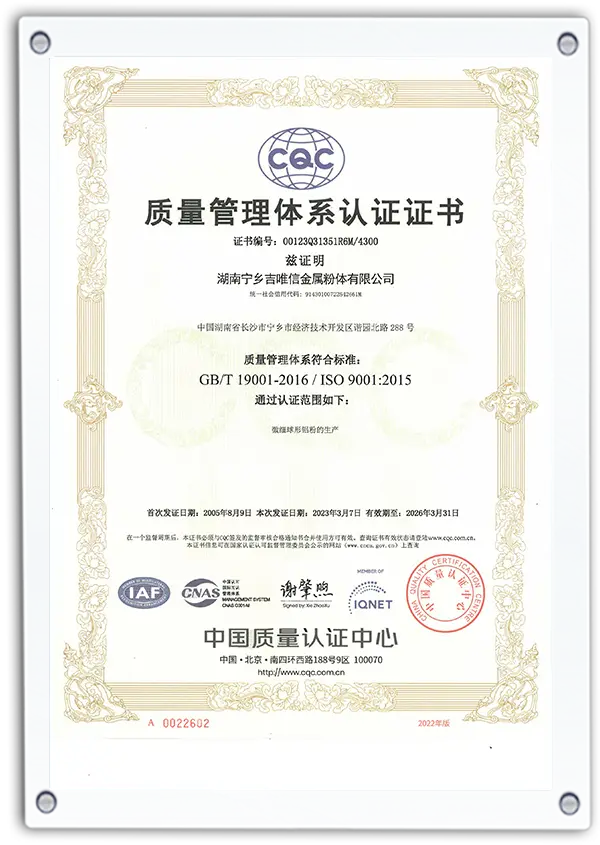
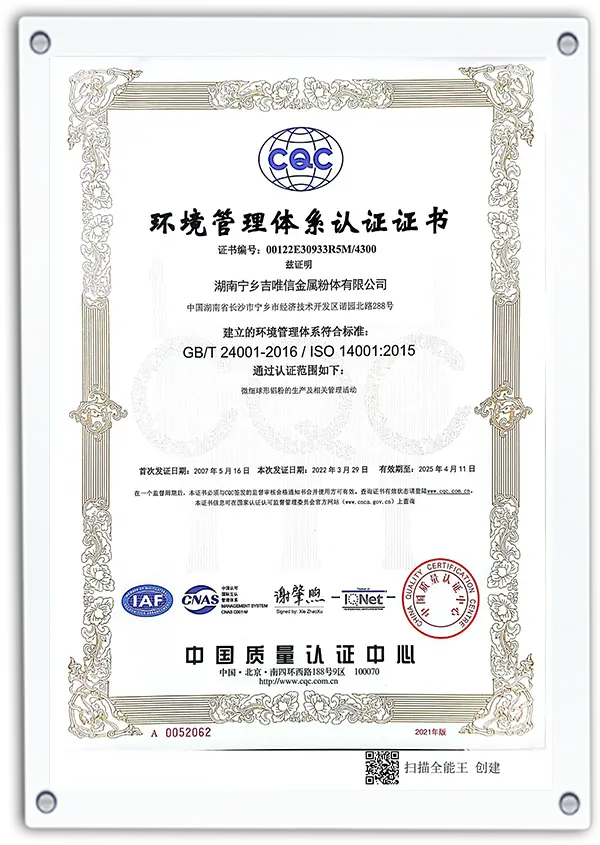
Transparent technical guidance addressing custom particle distribution, safety ratings, international shipping, and OEM capabilities.
Request quotes, sample testing kits (1kg / 5kg), and comprehensive technical datasheets directly from our metallurgical engineering team.
