What Are the Top Types of High Purity Aluminium Powder?

Time:2026-10-30 Author:Ethan
0%

High-Purity Aluminium Powder is not one uniform material. It describes aluminium powders with tightly controlled impurity levels, while particle shape, size, and production route vary. The USGS Mineral Commodity Summaries 2025 estimated worldwide primary aluminium production at about 72 million metric tons in 2024. That figure describes bulk metal, not powder, but it shows the scale of the supply chain behind specialised powder products.

For buyers and engineers, the useful distinction is practical. Atomized powders are often closer to spherical, while milled powders can be flake-shaped or irregular. Each form handles differently during blending, coating, or additive manufacturing. Purity is not one thing. A certificate should identify the measured aluminium content, relevant trace elements, particle-size distribution, and test method—not just use a broad “high purity” label. The International Aluminium Institute’s production statistics provide wider industry context, while supplier specifications and independent laboratory results are needed to assess a specific powder. Those sources answer different questions.

This guide compares the top types by morphology, production method, and typical selection criteria. A fine powder may look uniform in a sample jar, yet still contain a wide particle-size range. That detail is easy to overlook. The best choice depends on the application, handling requirements, and verified data, rather than purity claims alone. Some supplier descriptions remain vague; careful comparison is therefore part of the work.
What Are the Top Types of High Purity Aluminium Powder?

What Defines High-Purity Aluminum Powder?

High-purity aluminum powder is defined by its chemical composition, not by its color or particle shape. Commercial specifications often use “4N” for 99.99% aluminum and “5N” for 99.999%, but buyers should check the stated assay and test method. Small impurity levels matter. Iron, silicon, and copper can affect conductivity, sintering, and performance in finished components. A bright, fine powder is not proof of high purity.

The USGS Mineral Commodity Summaries 2025 estimated global primary aluminum production at about 72 million metric tons in 2024. That figure describes bulk metal, not high-purity powder; the distinction matters when evaluating supplier claims. Ask for a batch certificate showing elemental composition, particle-size distribution, and oxygen content. ICP-OES or glow-discharge mass spectrometry may help verify trace elements, depending on the specification. Powder handling can also introduce contamination, so test results should correspond to the delivered batch. “High purity” alone is too vague. Even a precise percentage can leave questions if the measurement method and impurity limits are missing.

How Is Aluminum Powder Classified by Particle Shape?

High-purity aluminium powder is classified by more than particle size. Shape matters too. Under a microscope, particles may appear spherical, flaky, irregular, or dendritic. Each form behaves differently during mixing, packing, and surface coverage.

Spherical powder has rounded grains that tend to flow and pack more evenly. A technician can observe this in a smooth stream of powder and consistent filling.

Flake-shaped particles are thin and broad, like tiny metal plates. Their larger surface area can support reflective finishes or conductive coatings, depending on the formulation.

Shape changes performance. Irregular particles have uneven edges and varied dimensions. They may interlock, which can affect flow and packing density. Dendritic particles branch outward, making their structure more complex than a simple sphere.

Classification is not always neat. A sample can contain several shapes, and production conditions may create mixed morphologies. Purity alone does not identify particle shape. Microscopy, particle-size data, and supplier specifications provide a more dependable picture than appearance alone. Not always. For careful evaluation, compare representative samples and check whether the stated shape matches the intended process.

Fine aluminium powder also requires appropriate dust controls and handling procedures.

What Distinguishes Spherical from Irregular Powder?

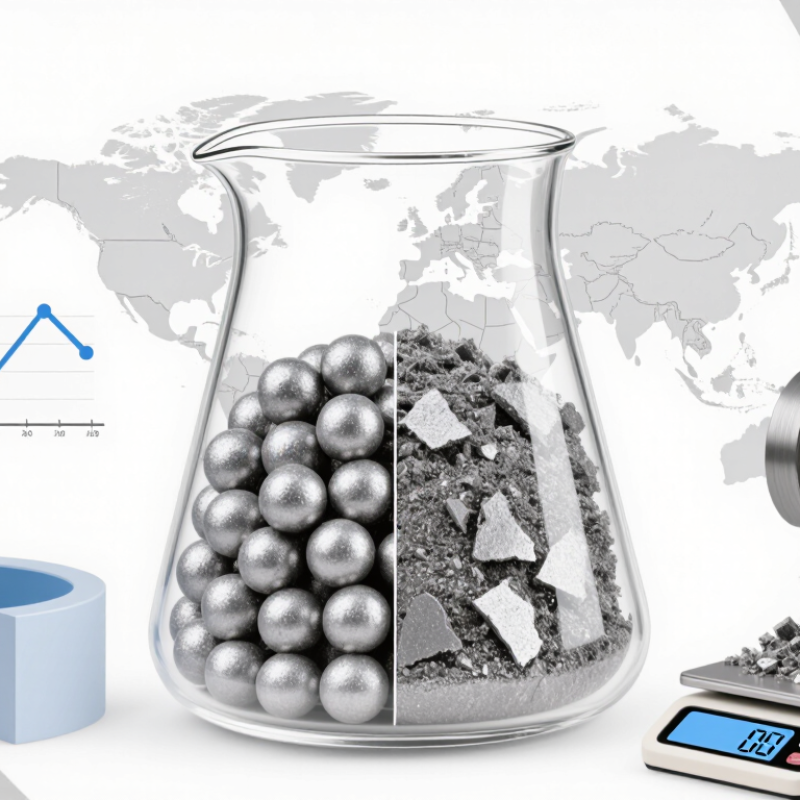
High-purity aluminium powder is commonly supplied in spherical and irregular forms. Shape affects handling and processing; purity describes chemical composition. The two properties are related only indirectly. Tiny metal beads.

Spherical particles are often produced through atomization. Their rounded surfaces help them flow through feeders and spread more evenly across a powder bed. This can support consistent dosing in processes that depend on uniform delivery. Still, spheres do not guarantee perfect results. Particle size distribution, surface condition, and equipment design matter too.

Irregular particles may come from mechanical milling or crushing. Their corners can interlock, making them less free-flowing and sometimes harder to spread evenly. Edges catch. For a similar particle size, irregular shapes may also expose more surface area, which can increase sensitivity to oxidation during storage and handling. The effect varies with particle size and conditions, so shape alone is not enough to judge performance. Compare the intended process with measured flow, particle-size data, and a chemical purity certificate. A small trial can reveal feeding or spreading problems that specifications miss. That practical check is easy to overlook.

High-Purity Aluminium Powder: Particle Size and Shape

Standard sieve openings provide a practical way to describe powder size; particle shape is a separate characteristic.

How to read the chart: The bars show nominal openings for ASTM E11 sieve numbers 100, 200, and 325: 150, 75, and 45 μm, respectively. These are sieve aperture sizes, not guaranteed particle-size distributions. Spherical powder, commonly made by atomization, generally flows more readily; irregular powder, often produced by milling, tends to interlock more. Either shape can occur across different size grades, and shape alone does not establish aluminium purity.

How Do Flake and Atomized Powders Differ?

Flake and atomized powders behave differently because their shapes change how particles move and contact each other. Flake powder is thin and plate-like, often made by milling aluminium. Its broad faces can create reflective surfaces and overlapping conductive paths in coatings. But flakes may bridge in a hopper, trap air, or clump during mixing. The detail matters: a powder that looks free-flowing in a jar can still feed unevenly on a production line.

Atomized powder forms from droplets that cool into mostly spherical particles. Those particles generally flow and pack more consistently, making them useful where dosing and repeatable blending matter. Shape is not the whole story; particle-size distribution, oxide films, and surface condition also affect performance. ASTM B213 provides a Hall-flow test for metal powders, while ISO 4497 specifies sieve analysis. These methods help compare batches, but neither alone predicts performance in every process. A test result needs context.

The scale of aluminium production is substantial: the USGS Mineral Commodity Summaries 2025 estimated 2024 global primary output at about 72 million metric tonnes. That figure describes aluminium metal, not powder, so it cannot establish powder availability or quality. A practical comparison should record flow time, sieve distribution, and how the powder handles in the intended equipment. Some judgment remains unavoidable.

What Are the Top Types of High Purity Aluminium Powder? - How Do Flake and Atomized Powders Differ?
Powder type Typical particle shape How it is produced Purity and particle-size considerations Typical characteristics Common application areas
Flake aluminium powder Thin, plate-like particles with a relatively large surface area compared with their thickness. Usually made by mechanically milling aluminium powder; milling conditions and any process aids affect the resulting flakes. Purity and size are grade-specific. Flake shape is a physical form, not a guarantee of a particular purity level or particle-size range. Can orient parallel to a coating surface, creating a metallic appearance and a barrier-like arrangement. Shape can make flow and handling differ from spherical powders. Metallic-effect coatings, printing inks, and selected pigment or surface-treatment applications.
Gas-atomized aluminium powder Generally spherical or near-spherical, though the shape and fraction of irregular particles depend on process conditions. Molten aluminium is broken into droplets by a high-velocity gas stream, then solidified into powder. Purity, oxygen content, and particle-size distribution depend on feedstock, atomization conditions, and classification. Specifications should be checked for each grade. Often offers good flow compared with irregular powders. Spherical morphology is useful where consistent powder feeding or packing is important. Metal additive manufacturing, thermal spraying, and other powder-metallurgy processes, subject to the grade and process requirements.
Water-atomized aluminium powder Often irregular or less spherical than gas-atomized powder. A water jet breaks up the molten metal; the droplets cool and solidify rapidly. Purity and size vary by production route and grade. Surface oxidation and moisture-related handling requirements should be considered in the product specification. Irregular particles may pack and flow differently from spherical powders; performance depends on size distribution and downstream processing. Selected powder-metallurgy and industrial formulations where the specified particle shape and cost-performance profile are suitable.
High-purity aluminium powder (composition class) May be supplied as flake, spherical, or irregular powder; “high purity” describes chemical composition rather than particle shape. Produced using a suitable aluminium feedstock and a powder-making process, followed by any required classification or treatment. Purity limits and permitted impurity levels must be taken from the supplier’s certificate of analysis and the applicable specification. Particle size is specified separately. Selection should account for impurities, oxide content, particle morphology, size distribution, and intended processing conditions. Specialty materials, chemical or metallurgical uses, and other applications that require a defined aluminium composition.
At-a-glance comparison Flake: plate-like. Atomized: commonly spherical for gas atomization and often irregular for water atomization. Flake: mechanical milling. Atomized: breakup and solidification of molten metal. Neither “flake” nor “atomized” alone establishes purity or a universal particle-size range. Compare morphology, flow, packing, surface condition, and the relevant grade specifications rather than relying on the process name alone. Choose according to the target process and verify the powder’s technical data and safety documentation.

How Do Purity Grades and Particle Sizes Affect Applications?

High-purity aluminium powder is selected by more than its headline purity. Trace elements can affect electrical and thermal performance, while surface oxides may influence bonding and processing. For conductive or chemical applications, compare certified composition data and test methods, not just a percentage. A higher grade is not automatically the best choice. Small differences matter.

Particle size shapes how the powder behaves. Fine particles offer more surface area, which can support faster sintering or finer coatings, but they may agglomerate and handle less easily. Coarser particles often flow and pack more consistently, though they can leave a rougher finish. Check the size distribution as well as the average: two powders with the same average size may perform differently. Still, this is not a perfect rule; particle shape and process settings also matter.

Tips: Match purity and size to the end use, then request a lot-specific certificate and particle-size report. Test a small sample under real process conditions. Record flow, dispersion, and finished-part results. Don’t rely on a specification sheet alone.

FAQS

What does “high-purity” aluminum powder mean?

It describes chemical composition, not color or appearance. “4N” commonly means 99.99% aluminum; “5N” means 99.999%. Check the assay and test method. A bright powder proves little.

Which impurities should buyers check?

Iron, silicon, and copper can affect conductivity, sintering, and finished-part performance. Ask for elemental results and oxygen content. Small details matter.

What should a batch certificate include?

Look for composition, particle-size distribution, oxygen content, and test methods. Results should match the delivered batch. A generic sheet is not enough.

How can trace elements be verified?

ICP-OES or glow-discharge mass spectrometry may help, depending on the specification. The method should suit the limits being checked. I’d still inspect the actual batch data.

Does global aluminum production data describe high-purity powder?

No. An estimate of about 72 million metric tons in 2024 refers to global primary aluminum production. It does not measure high-purity powder output.

What particle shapes are common?

Powder may be spherical, flaky, irregular, or dendritic. Spherical grains often flow evenly. Flakes resemble tiny metal plates. Irregular grains can interlock; dendritic grains have branching structures.

How do particle size and shape affect performance?

Fine particles offer more surface area, but may clump. Coarser particles may flow and pack more consistently, yet leave rougher finishes. Shape and process settings matter too.

How should a powder be evaluated for an application?

Match purity and size to the intended use. Review a representative sample under real process conditions, and record flow, dispersion, and finished-part results. Specifications alone can miss things. Use appropriate dust controls and handling procedures.

Conclusion

High-Purity Aluminium Powder is defined by its aluminium content and the controlled level of impurities, both of which influence its consistency and suitability for different uses. It can be classified by particle shape, with spherical, irregular, and flake forms offering distinct physical characteristics. Spherical particles tend to flow and pack more evenly, while irregular particles have varied edges and may behave differently during processing.

Flake powders are thin and plate-like, whereas atomized powders are produced as droplets that solidify into particles, often with a more rounded shape. These differences affect handling, surface area, and performance in a given process. Purity grade and particle size are also important: finer particles provide greater surface area, while coarser sizes may offer different flow and handling properties. Selecting the right type means matching its purity, shape, and size to the intended application.


Ethan

Ethan

Ethan is a seasoned marketing professional with a deep expertise in our company's innovative product line. With a passion for sharing knowledge and insights, he takes the lead in regularly updating our corporate blog, where he explores industry trends, product features, and effective marketing......
