Choosing a High Purity Aluminum Powder supplier takes more than comparing prices or reading a polished product sheet. Small differences in purity, particle size, oxide content, and batch consistency can affect processing and finished-part performance. A specification should match your application, not simply display impressive numbers. Details matter.
Dr. Mira Chen, a fictional materials-science specialist used here to express an editorial viewpoint, puts the selection principle this way: “Trust the test report only when its methods, limits, and batch identity are clear.” This is an original illustrative quotation, not a sourced statement. It reflects a practical point: reliable purchasing depends on evidence that can be checked.
Ask for a current certificate of analysis tied to the specific lot. Review the stated test methods, sampling details, and measurement units. Confirm how the supplier controls particle-size distribution and prevents contamination during handling and packaging. Then compare those details with your own incoming-inspection requirements. A clean sample jar is useful, but it cannot establish lot-to-lot consistency.
Supplier experience matters too. Look for clear answers about traceability, packaging, storage conditions, lead times, and technical support. Request representative documentation before placing a large order, and assess whether the supplier explains limitations as openly as product strengths. No supplier is perfect. Even a strong specification can leave questions about real-world process fit. A careful qualification process helps surface those gaps before they become costly production surprises.
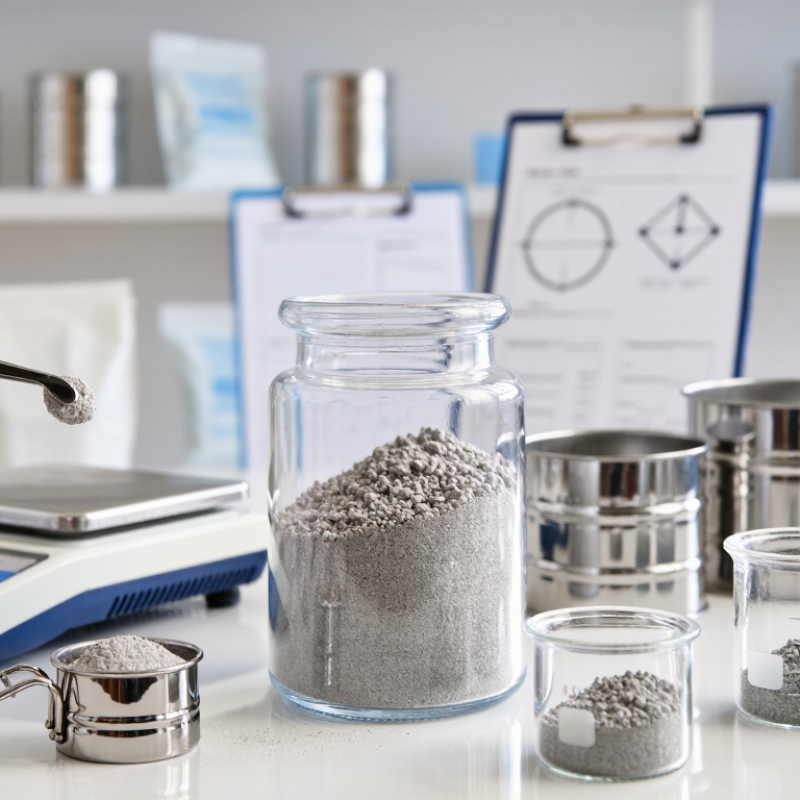
High-purity aluminum powder is finely divided metal with a stated aluminum content, usually confirmed through chemical analysis. The purity figure alone does not tell the full story. Trace iron, silicon, or other elements may affect conductivity, sintering, or coating performance. A thin surface oxide can also influence particle behavior, even when the bulk assay looks excellent. Small details matter.
Particle-size distribution affects flow, packing, and surface area. Spherical particles may flow differently from irregular ones, so morphology should suit the intended process. Production method matters, too. Check moisture limits, bulk density, and the test methods used to report each value. Request a current certificate of analysis and confirm that it applies to the specific lot being supplied.
Packaging condition and clear storage guidance deserve attention as well. Aluminum powder can create combustible dust, so handling should follow the supplier’s safety documentation and site procedures. Specifications may still leave unanswered questions; ask for clarification before comparing quotations.
Before requesting quotes, define what “high purity” means for your process. A 99.9% figure alone is incomplete. Specify the assay basis and limits for iron, silicon, copper, oxygen, and moisture, where relevant. Ask how each value is measured and whether the certificate reports actual results or typical values. Small differences matter.
Particle size needs equal care. State the target range, not just “fine powder,” and identify whether you need a D10, D50, and D90 distribution or a maximum sieve size. A powder with a 20-micrometer median can still contain coarse particles that affect mixing or surface finish. Confirm the test method, sampling procedure, and whether results describe the shipped lot. These details reduce surprises.
Match the grade to the use. Requirements can differ for powder metallurgy, thermal materials, or research batches, so avoid choosing by purity alone. Request a current certificate of analysis, lot identification, packaging details, and storage guidance. Compare documented controls with your own acceptance criteria. If data are missing, ask before purchase. Specifications are sometimes copied forward without checking the process. It is easy to do, and worth questioning. A neat datasheet is not proof of fit.
How to Choose High Purity Aluminum Powder Suppliers
Assessing Supplier Quality Systems and Product Documentation
A supplier’s quality certificate is a starting point, not proof that every batch is consistent. The ISO Survey 2022 recorded more than 1.2 million ISO 9001 certificates worldwide. This figure shows how widely quality systems are used; it does not verify a powder’s purity or particle-size distribution. Ask for the certificate’s scope, issuing body, and expiry date, then check that the certified site actually makes or tests your material.
Review a recent, lot-specific certificate of analysis. It should identify the batch and report purity, particle-size distribution, and test methods. Check whether purity is reported on a metallic basis, and ask how oxygen and other impurities are measured. For particle size, look for D10, D50, and D90 values, not just “fine powder.” Request the sampling procedure and instrument method, too. Details matter.
Traceability should connect the batch to production, testing, and packaging records. Ask how the supplier handles out-of-specification results, process changes, and retained samples. A clear answer is reassuring. Vague paperwork is not. I would also compare several certificates rather than judge one polished sample; documents can look tidy while hiding inconsistent reporting. That deserves a second look.
| Assessment Dimension | Evidence to Request | What to Check | Evaluation Guidance |
|---|---|---|---|
| Quality management system | Current quality-system certificate, scope statement, and relevant audit information | Confirm the certificate is current and its scope covers the site and activities relevant to the powder being supplied. Verify certification details with the issuing body where appropriate. | Treat certification as evidence of a management system, not as proof that every product lot meets its specification. |
| Purity specification | Product specification and a representative, lot-specific certificate of analysis (CoA) | Check that aluminum content and impurity limits are stated with units, test methods, and a clear basis for reporting. Confirm whether results are reported as mass fraction or another defined basis. | Compare the stated limits with the application’s requirements. Do not rely on a general “high purity” description without defined limits. |
| Analytical methods and laboratory competence | Test-method descriptions, laboratory details, and accreditation scope when applicable | Confirm methods are suitable for the elements and concentration ranges being reported. Methods such as ICP-OES or ICP-MS may be used for elemental analysis, depending on the analytes and validated method. | Check whether the laboratory’s accreditation scope covers the relevant tests; accreditation for one method or analyte does not automatically cover all analyses. |
| Lot identification and traceability | Sample labels, CoA, packaging records, and a description of the traceability system | Ensure the lot or batch identifier matches across the CoA, container label, and shipping documents. Ask how records connect incoming materials, processing, testing, and shipped product. | Require a documented way to identify and investigate affected lots if a nonconformance or recall occurs. |
| Particle size and distribution | Particle-size specification and test report stating the method and distribution metrics | Review the stated range or percentile values, units, sample-preparation procedure, and measurement method. Laser diffraction or sieving may be appropriate depending on the particle-size range and product requirements. | Compare results only when methods and reporting bases are sufficiently comparable. Request clarification for terms such as “fine” or “micronized” that lack numerical limits. |
| Powder characteristics and handling | Product specification, applicable handling instructions, and safety data sheet (SDS) | Check that the documentation identifies relevant physical hazards and gives handling, storage, spill, and exposure-control guidance for the specific product form. | Fine metal powders can present combustible-dust hazards. Follow the product SDS and site-specific risk assessment; do not assume all powder grades have identical hazards. |
| Packaging and contamination control | Packaging specification, sealing or liner details, and contamination-control procedures | Confirm packaging is suitable for the product and transport conditions, protects against contamination and moisture as specified, and carries a legible lot identifier. | Agree on packaging, storage conditions, and inspection criteria before ordering, especially where surface condition or contamination limits are critical. |
| Nonconformance and corrective action | Documented complaint process, corrective-action procedure, and anonymized examples where available | Look for a process to contain affected lots, investigate root causes, document corrective actions, and communicate findings to customers. | Assess whether the supplier can provide timely, lot-specific responses and preserve relevant records. |
| Change control | Change-notification policy covering materials, manufacturing, testing, and packaging | Check whether changes that may affect agreed product characteristics are reviewed and communicated before implementation, as defined in the purchasing agreement. | Define which changes require advance notice or customer approval rather than relying on an informal assurance. |
| Regulatory and shipment documentation | SDS, transport information, declarations, and other documents required for the destination and intended use | Confirm documents are current, product-specific, and consistent with the shipping classification and applicable destination-market requirements. | Requirements vary by jurisdiction, product form, and use. Confirm applicability with qualified regulatory and transport personnel. |
| Sample approval and ongoing verification | Pre-production or qualification sample, agreed acceptance criteria, and a lot-verification plan | Establish the tests, sampling approach, documentation, and acceptance limits before routine purchasing. Determine how discrepancies between supplier and customer results will be resolved. | Use risk-based verification and periodic review; the appropriate testing frequency depends on the application, supplier history, and consequences of failure. |
Choosing a high-purity aluminum powder supplier means checking more than a certificate of analysis. Ask for a current safety data sheet and clear guidance on storage, handling, and personal protective equipment. Aluminum powder can create combustible dust hazards, so confirm that the supplier explains relevant controls and trains staff who handle the product. Details matter. Request lot-specific purity results and traceability records, then compare them with your requirements.
Tips: Check that containers arrive sealed, clearly labeled, and suitable for the powder’s particle size and shipping conditions. Ask how packaging protects against moisture, punctures, and accidental opening. Request photos or a packaging specification if the shipment is new to you. Small gaps can matter.
Shipping capability is part of product quality. Confirm the supplier can coordinate with a carrier that accepts the material and can provide required shipping documents. Ask about lead times, shipment tracking, and what happens if a package is delayed or damaged. A supplier should explain these steps plainly, not offer vague assurances. A checklist helps, though it cannot replace a careful review of your own site’s receiving procedures. Even experienced buyers may miss a detail when specifications change.
Choosing a high-purity aluminum powder supplier takes more than comparing purity figures. Ask for a recent certificate of analysis and check whether it identifies the tested batch, measurement method, and impurity limits. Traceable records matter. A polished data sheet is useful, but it cannot replace consistent batch documentation. Request a sample when practical, then compare its stated particle-size range with your process requirements.
Price comparisons should include more than the cost per kilogram. Check minimum order quantities, packaging, shipping, and fees for additional testing. A lower quote may reflect different specifications or less technical support. Compare like with like. I would also ask how the supplier handles a delayed shipment or a result outside specification; the answer can reveal more than a sales promise. No checklist removes every risk.
Technical support is especially valuable when powder behavior affects mixing, flow, or finished-part consistency. Ask whether staff can explain test methods and discuss storage or handling requirements relevant to your application. Try a specific question before placing a large order. Note how quickly the reply arrives and whether it addresses the actual issue. A slow response is not always a deal-breaker, but it deserves attention. Supplier claims can sound reassuring; evidence is less tidy, and sometimes that is where careful judgment begins.
Define the assay basis and limits for iron, silicon, copper, oxygen, and moisture. A 99.9% figure alone is incomplete.
Specify a target range, such as D10, D50, and D90, or a maximum sieve size. Ask for the test method and sampling procedure. Fine powder can still contain coarse particles.
Match the grade to its intended use, such as powder metallurgy, thermal materials, or research batches. Purity alone is not enough.
Request a current certificate of analysis, lot identification, packaging details, and storage guidance. Check whether results are actual measurements or typical values.
Compare documented controls with your acceptance criteria. Ask about missing results or unclear methods. A polished datasheet is not proof of fit.
Request a current safety data sheet and clear storage, handling, and protective-equipment guidance. Aluminum powder can create combustible dust hazards. Details matter.
Confirm containers arrive sealed, clearly labeled, and suitable for the powder and shipping conditions. Ask how packaging limits moisture, punctures, and accidental opening.
Ask about carrier acceptance, required documents, lead times, tracking, and procedures for delayed or damaged packages. Check your own receiving process, too. A checklist helps, but it can miss a detail.
Choosing a High Purity Aluminum Powder supplier begins with understanding how purity, particle size, and material grade affect the intended application. Define these requirements clearly before requesting quotations, and confirm that the supplier can provide consistent specifications and suitable testing information. A supplier’s quality systems and product documentation can help you assess traceability, batch consistency, and confidence in the material.
Also review how the powder is packaged, stored, and shipped, including whether the supplier provides clear handling and safety information. Compare suppliers on delivery reliability, pricing transparency, responsiveness, and access to technical support—not price alone. A careful evaluation of product fit, documentation, logistics, and service helps you select a dependable supplier and reduces the likelihood of delays or mismatched materials.

